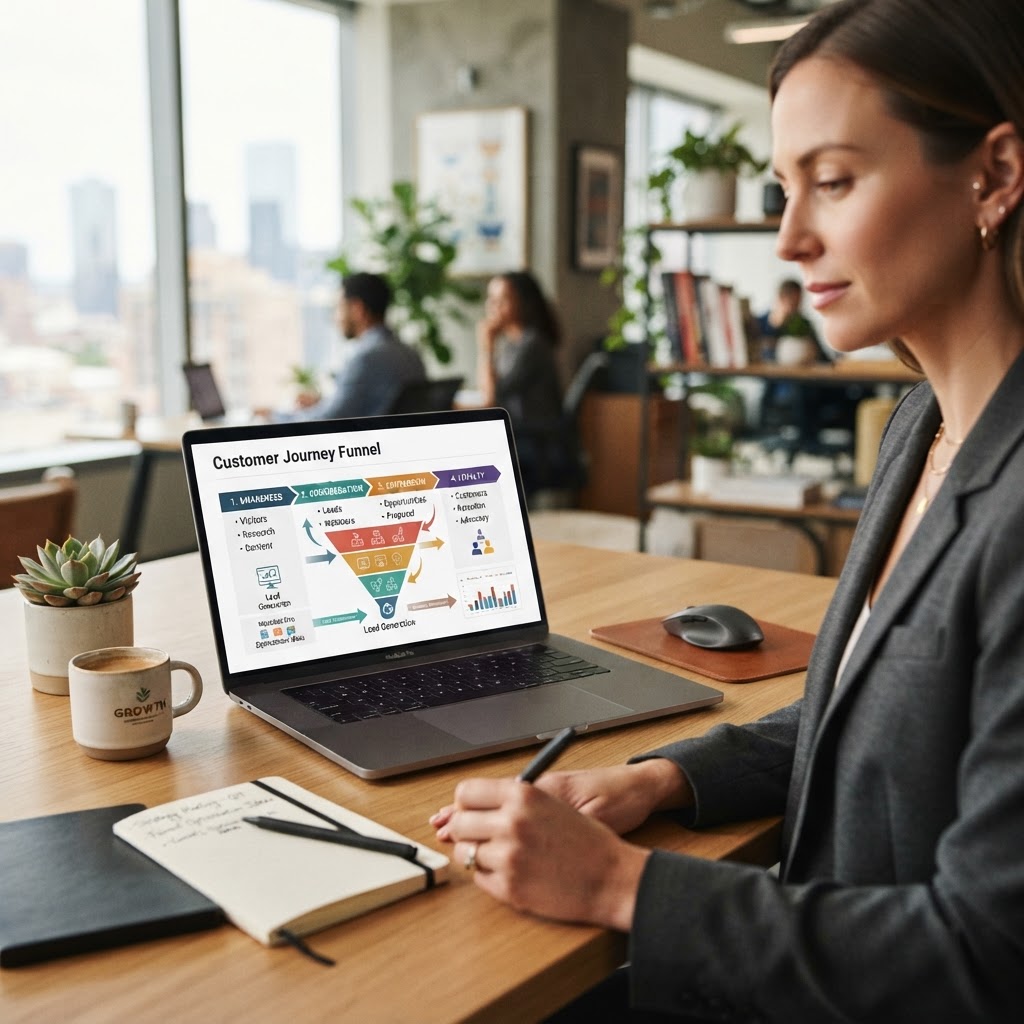
What a funnel is
A funnel is the path a stranger takes to become a customer: they land on a page, give you their email, get nurtured, and book a call. Each stage narrows the crowd — that's the 'funnel' shape. A high-converting funnel isn't about tricks; it's about removing friction at every step so the right people keep moving.
- Top: traffic lands on your page
- Middle: they exchange an email for something useful
- Bottom: they book a call or buy
- Every step should have one clear next action
Define the one offer
Before you build anything, decide the single thing your funnel asks for. Not 'learn about us' — that's vague. A specific, valuable offer: a free audit, a checklist, a 15-minute consult. The offer is the hinge; everything else exists to deliver it. If the offer is weak, no layout will save the funnel.
- Pick one offer per funnel (don't mix goals)
- Make it specific and immediately useful
- Ensure it's relevant to who you want as a customer
- Write the offer as a one-line headline before building
Build a focused landing page
Your landing page has one job: get the email. Cut the nav bar, the footer links, the 'about us' — anything that lets people wander off. Headline states the offer, a short line explains it, and a form sits above the fold. Social proof (a logo, a quote) helps if you have it.
- Use the Funnels builder → New funnel → Landing page
- Headline = the offer, subhead = the benefit
- Form above the fold, ask for name + email only
- Remove navigation and external links entirely
Set up the nurture sequence
The moment someone opts in, start a short email sequence. The first email delivers the offer instantly. The next two or three build trust and gently steer toward booking. Space them a day apart. Each email should have one link — the same booking link every time.
- Email 1 (immediate): deliver the offer + booking link
- Email 2 (day 1): a relevant story or quick win
- Email 3 (day 2): a case study or social proof
- Email 4 (day 3): a direct invitation to book
Make booking frictionless
The bottom of the funnel is the booking. Connect your calendar so people pick a time themselves — no back-and-forth emails. Put the booking link in every nurture email and on the thank-you page. The fewer fields and clicks between 'interested' and 'booked,' the higher you convert.
- Connect your calendar under Calendar → Integrations
- Add the booking link to the thank-you page
- Include it in every nurture email
- Ask only for name + email + the time slot
Pro tip: one goal per funnel
A funnel that tries to sell, book, and educate at once converts on nothing. Each funnel should chase a single outcome. Want a second outcome? Build a second funnel. Focus is the highest-leverage conversion tactic there is.
Common mistakes to avoid
Asking for too much
Every extra form field cuts conversions. If you only need name and email, don't ask for phone, company, and job title. Add fields only when you'll actually use them.
Leaving escape hatches
Nav menus, blog links, and social icons on a landing page give people a way out before they convert. Remove them — the only clickable thing should move them toward the offer.
No follow-up after opt-in
Capturing the email is half the job. If nothing happens for three days, the lead goes cold. An instant first email keeps momentum and dramatically lifts booking rates.